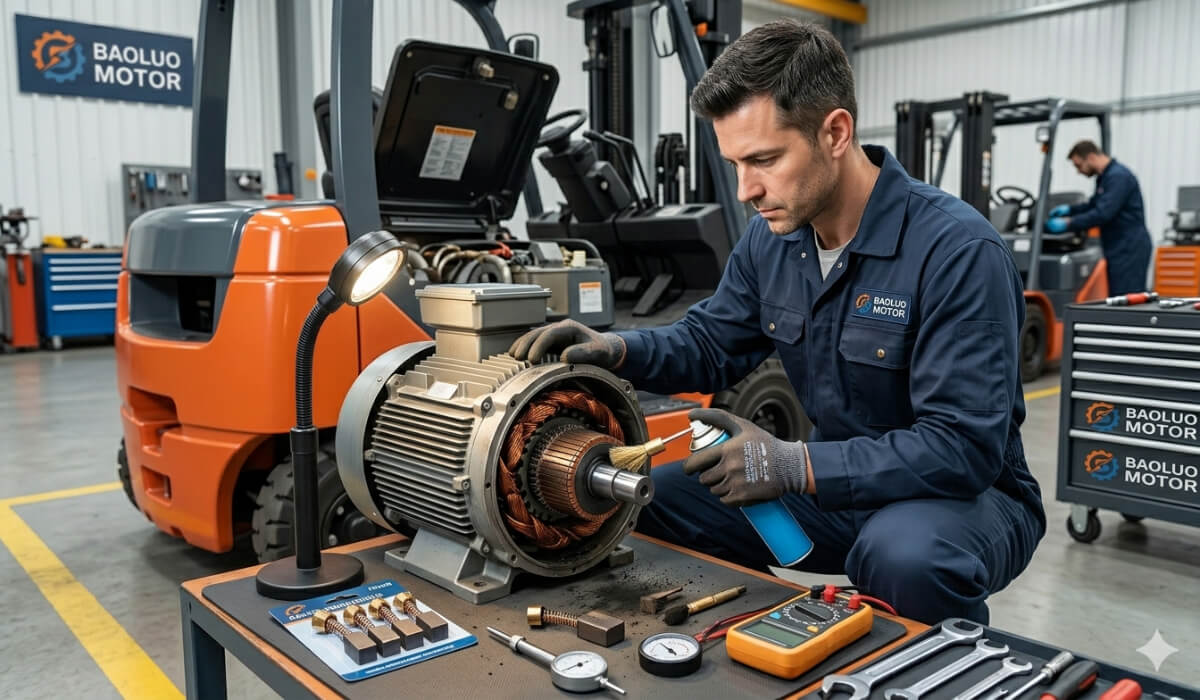
Many electric forklift operators experience a frustrating problem: the forklift can lift and lower normally, but it suddenly refuses to move forward or reverse. Sometimes it works, sometimes it doesn't.
In many cases, operators immediately suspect the controller, contactors, accelerator system, or even the traction motor itself. However, after excluding brake-related issues, one of the most common causes is surprisingly simple: dirty or poorly contacting carbon brushes.
Because the hydraulic system still operates normally, battery power is usually available. This often indicates that the issue is located within the traction motor circuit rather than the main power supply.
Many electric forklifts still use brushed DC traction motors due to their strong starting torque, simple structure, and cost-effective maintenance.
Carbon brushes are responsible for transferring electrical current from the stationary part of the motor to the rotating armature through the commutator.
Over time, carbon dust, oil contamination, moisture, and debris can accumulate inside the motor. When this happens, brush contact becomes unstable and electrical conductivity decreases.
As a result, the forklift may:
In this repair case, the forklift owner reported that the vehicle would sometimes move and sometimes fail to respond when selecting forward or reverse.
The lifting and lowering functions worked perfectly, leading many technicians to initially suspect the controller or directional contactors.
After inspection, the actual cause was found inside the DC traction motor. The carbon brushes and commutator area were heavily contaminated with carbon dust and dirt buildup.
Once the brushes were cleaned and proper contact was restored, the forklift returned to normal operation without replacing expensive electrical components.
Regular motor maintenance can significantly extend the service life of electric forklifts.
Although AC drive systems have become increasingly popular, DC brushed traction motors remain widely used in forklifts, tow tractors, electric pallet trucks, flatbed carriers, and industrial vehicles.
Their advantages include:
If your forklift can lift normally but refuses to move forward or reverse, don't immediately assume the controller or motor has failed.
After eliminating brake-related issues, dirty carbon brushes are often one of the first components worth checking. A simple cleaning procedure may solve the problem and save considerable repair costs.
This usually indicates that battery power is available and the hydraulic system is functioning. The problem is often related to the traction motor circuit, brushes, controller, contactors, or brake system.
Yes. Excessive carbon dust or poor brush contact can interrupt current flow to the armature, causing intermittent forward and reverse operation.
Inspection intervals depend on operating hours and working conditions, but periodic maintenance is recommended to prevent unexpected failures.
Not necessarily. Many intermittent drive issues are caused by brush wear, dirty commutators, loose connections, or maintenance-related problems rather than motor failure.
Worn brushes, contaminated brush holders, carbon dust accumulation, and poor commutator contact are among the most common causes.
Yes. Cleaning contamination and restoring proper electrical contact can often improve motor reliability, reduce sparking, and restore normal driving performance.
Baoluo Motor specializes in DC brushed motors, traction motors, low-voltage AC motors, motor controllers, drive wheels, and industrial electric vehicle power systems.
Website: https://www.baoluomotor.com
WhatsApp: +86 134 0169 0130
Looking for a Reliable Motor Supplier?
Send us your technical requirements, and our engineers will provide a detailed solution and quote within 24 hours.
Address: No. 38, Dahongqi West Road, Changzhou City, Jiangsu Province
WhatsApp:+8613401690130
Email: sale@mail.baoluomotor.com
tomasyue0424@gmail.com
Copyright © 2026 Changzhou Baoluo Electric Motor Co., Ltd. All Rights Reserved.

Hello, I am the online customer service


