
By the Baoluo Motor Engineering Team · Published 2026-06-10 · Updated 2026-09-04
A customer in Vietnam once shipped us a competitor's motor and asked a fair question: why does yours cost more? Same 48 V rating, same 4 kW class, and from the outside the two units were almost twins. We put both on the bench and opened them up. The difference was not in the nameplate — it was in the copper, the brushes, and whether anybody had actually balanced the rotor before it was boxed.
That is what this guide is for. If you source brushed DC traction motors for forklifts, tow tractors, AGVs, pallet trucks, golf carts or rail transfer cars, these are the eight things worth checking before you sign a purchase order — not after the third failure.
Rule of thumb: if you only have time to check three things, check copper purity, brush-and-commutator quality, and whether the maker load-tests every single unit. Those three decide most of the service life you will actually get.
Motor quality shows up in four places you feel every day: equipment uptime, what you spend on maintenance, how often a machine is pulled out of service, and how your own customers rate the equipment you built. In a DC traction motor, component quality drives reliability, efficiency and running cost all at once.
Get it right and you buy: longer service life, higher efficiency, less heat, fewer service calls, better uptime, and a cleaner return on the money. Get it wrong and you pay for the same motor twice — once at purchase and again in downtime.
Not sure whether brushed DC or three-phase AC is the right starting point for your build? That is a separate decision, and we wrote it up here: DC vs AC traction motor.
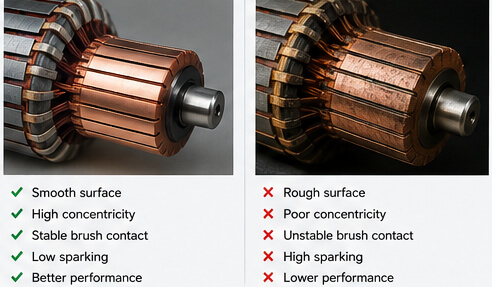
Copper windings are the heart of a brushed DC motor. Purity and fill decide how much of your battery ends up as torque instead of heat. Lower-purity or aluminium-substituted windings raise resistance, which raises copper loss, which raises temperature — and heat is what kills insulation and shortens life.
| Factor | High quality motor | Low quality motor |
|---|---|---|
| Copper purity | High | Reduced |
| Efficiency | ★★★★★ | ★★ |
| Heat generation | Low | High |
| Service life | Long | Short |
Ask the supplier one direct question: is it full copper, or copper-clad aluminium? A serious maker will answer in writing. Every Baoluo traction winding is full copper — you can see it in the build of our 48V 4.2 kW XQ-4.2-2A1.
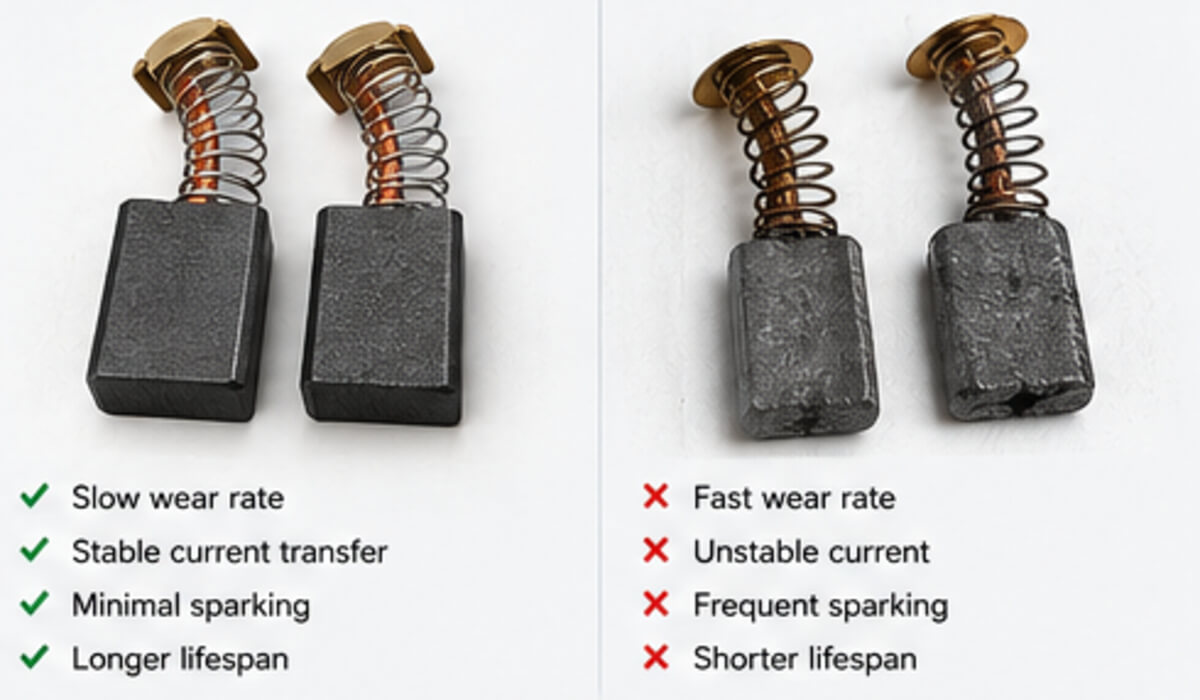
Carbon brushes carry the current into a spinning armature, so they sit right at the centre of three things buyers complain about: sparking, commutator wear, and unplanned stops. Brush grade, spring pressure and seating all matter.
Two practical numbers to hold a supplier to. Baoluo specifies a carbon-brush inspection every 2,000–3,000 operating hours, and brushes are replaced once worn past one third of their original length. On our XQ series the brush contact face is ground to match the commutator diameter, so it seats properly, transfers current evenly and wears flat instead of digging in.
Brushes are also the single most common cause of a DC motor dying early. We broke down why in DC motor failure causes.
A precision-machined commutator runs smoother, wears brushes more slowly and keeps sparking in check. Surface finish, bar-to-bar concentricity and mica undercutting all show up here — and a commutator that is already scored will eat new brushes no matter how good they are.
One thing worth checking with any supplier: if a motor has been sparking badly, swapping brushes alone will not fix a grooved commutator. Inspect both. That interaction is covered in DC motor failure causes.
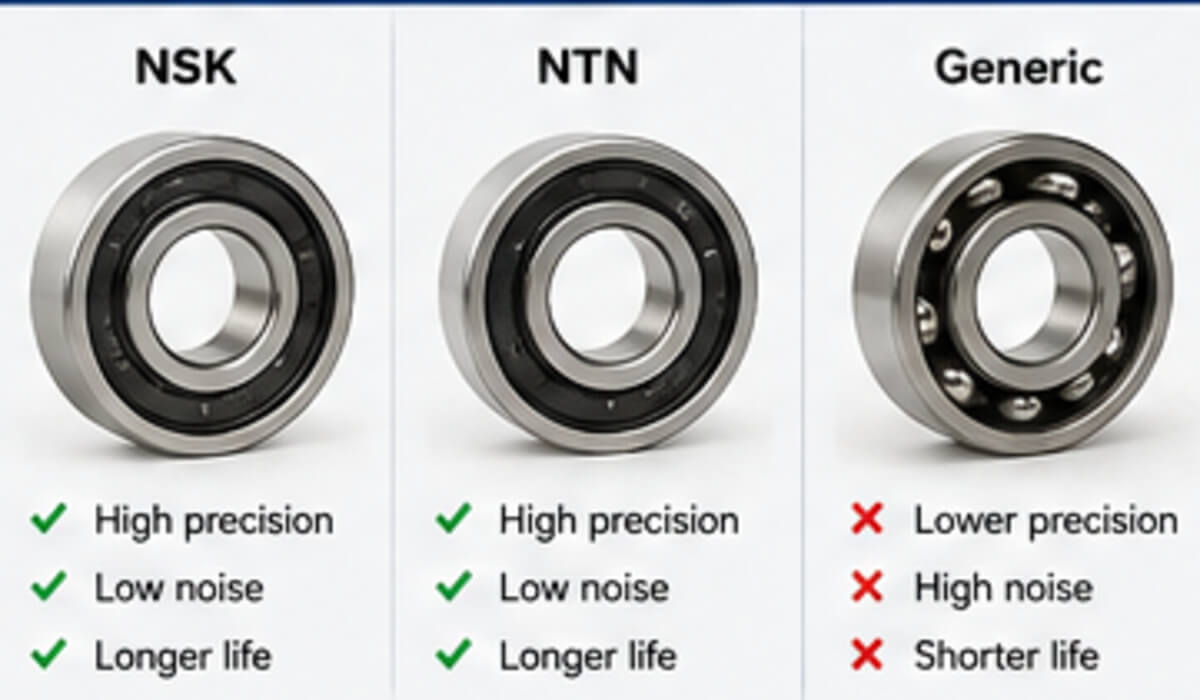
Good bearings cut vibration and noise and stretch the whole motor's life. Cheap ones fail early and usually take the shaft or the end cover with them.
| Bearing brand | Reliability |
|---|---|
| SKF | ★★★★★ |
| NSK | ★★★★★ |
| NTN | ★★★★★ |
| Generic | ★★ |
Note on brands: the exact bearing brand fitted depends on the bill of materials for your order. Confirm which brand your batch will carry when you request a quote.
Bearing type matters as much as brand. Deep-groove ball bearings suit most small and mid-size motors. Cylindrical roller bearings handle the drive end of higher-power units where radial load is heavy. Spherical roller bearings self-align and absorb shock in heavy traction and high-vibration work. Our 48V 0.8 kW XQ-0.8-3X is a typical small-duty example.
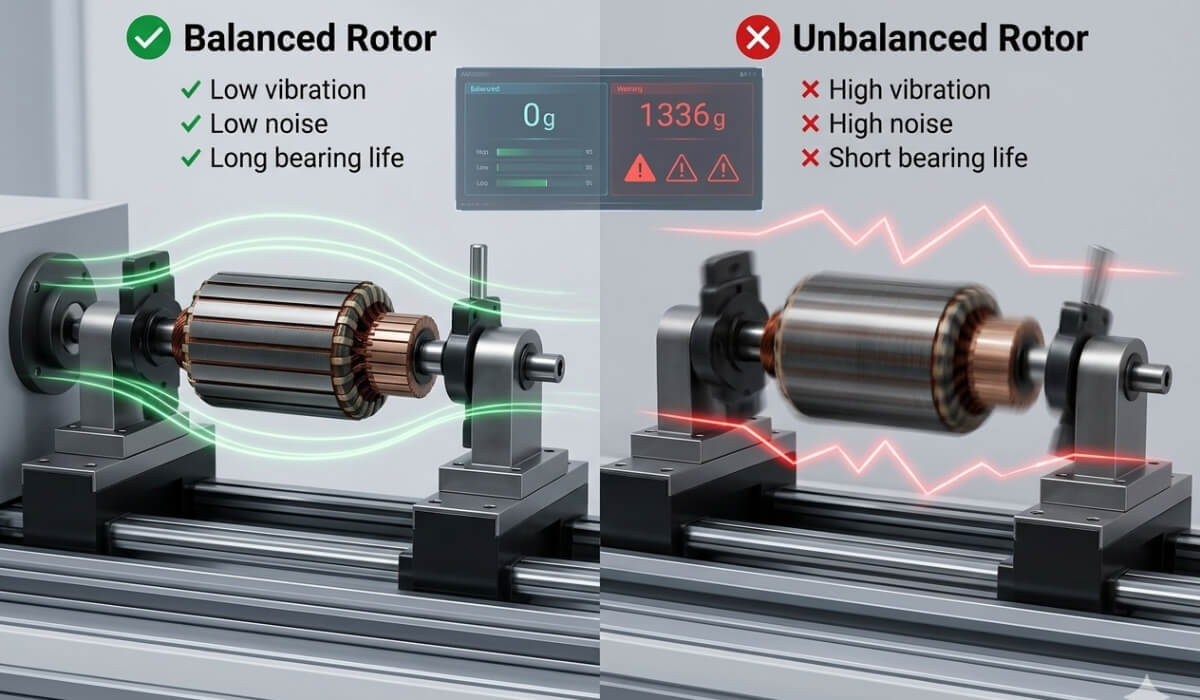
Proper dynamic balancing cuts vibration and extends bearing life, and it matters most in heavy-duty traction work where the motor spends its day starting and stopping under load. An unbalanced rotor does not just hum — it loads the bearings unevenly and shortens their life.
Every Baoluo motor leaves the factory after 100% load testing, dynamic balancing and electrical safety inspection. That is not a batch sample; it is each unit.
Insulation class is the temperature ceiling the winding system can live at. These classes follow IEC 60085, and the differences are large:
| Class | Max temperature | Allowable rise (resistance method) | Typical use |
|---|---|---|---|
| A | 105°C | 60K | Obsolete, older equipment only |
| E | 120°C | 75K | Small motors |
| B | 130°C | 80K | General industrial standard |
| F | 155°C | 100K | Industrial traction motors (mainstream) |
| H | 180°C | 125K | High temperature, heavy duty, explosion-proof |
| C | 220°C+ | 150K+ | Extreme high temperature |
Baoluo's recommendation: specify F class (155°C) as the floor for a traction motor, and H class (180°C) for explosion-proof or genuinely hot duty. F gives you 25°C more headroom than B, which is real protection during repeated heavy starts and full-load grades.
The class tells you the ceiling, not how much of it is left. On a motor that has been in service for years, a megger test between the winding and the frame tells you the rest: a reading near zero means the insulation has already gone to earth. We opened one that had run for ten years without a service, and that is exactly what we found. See our DC motor failure case study.
Here is the trap to watch. Ask whether the quoted figure is the insulation class or the temperature-rise class. Some suppliers advertise F-class insulation but assess temperature rise to the B-class limit of 80K. It is safe, but it means you are paying for headroom the design never uses.
Why this is worth arguing about: insulation life roughly halves for every 10°C you add to its working temperature. A motor that runs hot does not fail dramatically — it just quietly gets old faster.
A reliable maker runs inspection at several stages rather than testing one unit per pallet. Ours runs eight:
Ask a supplier which of these they run on every motor, and which they run on a sample. The answer tells you most of what you need to know.
Baoluo Motor builds brushed DC traction motors, AC induction motors, motor controllers, drive wheels and complete electric vehicle power systems. Where we sit against the field:
| Evaluation dimension | Baoluo Motor | Average supplier | Low-cost supplier |
|---|---|---|---|
| Copper windings | ★★★★★ | ★★★★ | ★★ |
| Carbon brushes | ★★★★★ | ★★★ | ★ |
| Commutator precision | ★★★★★ | ★★★ | ★ |
| Reliability | ★★★★★ | ★★★★ | ★★ |
| Expected service life | 8,000–12,000+ hours | 4,000–8,000 hours | 1,500–4,000 hours |
Service-life figures are Baoluo in-house figures for industrial duty. Real life depends on your duty cycle, load and ambient temperature — send us those and we will give you a number that means something for your machine.
Check copper quality, carbon brushes, bearings, insulation class, the balancing process, and what the manufacturer actually tests. A DC traction motor that scores well on those six will usually outlast one that only looks good in photos.
Mostly the same short list: poor brush grade, low copper content, inferior bearings, insulation that is under-rated for the heat, and quality control that samples instead of testing every unit.
A properly built traction motor commonly reaches 8,000–12,000 operating hours or more in industrial service, assuming the duty cycle matches the rating and brushes are inspected on schedule.
A series-wound motor (also called a DC series motor) puts out very high torque at low speed, which is exactly what a loaded forklift or a winch needs at the moment it starts moving. That is why the XQ series is still specified for carts, winches and forklifts that start under load rather than running at a steady cruise.
Yes. Higher copper purity lowers resistance, which reduces heat and improves efficiency. It also slows insulation ageing, because the winding simply runs cooler.
It depends on duty. Brushed DC wins on purchase price and starting torque; AC asynchronous wins where you want commutator-free running and precise speed control from an inverter. Full comparison: DC vs AC traction motor.
If you are comparing two quotes that look identical on paper, send us both and tell us the duty cycle. We will point at the parts that actually differ — usually copper, brushes and whether the maker load-tests each unit.


Hello, I am the online customer service


