By the Baoluo Motor Engineering Team · Published 2026-10-13
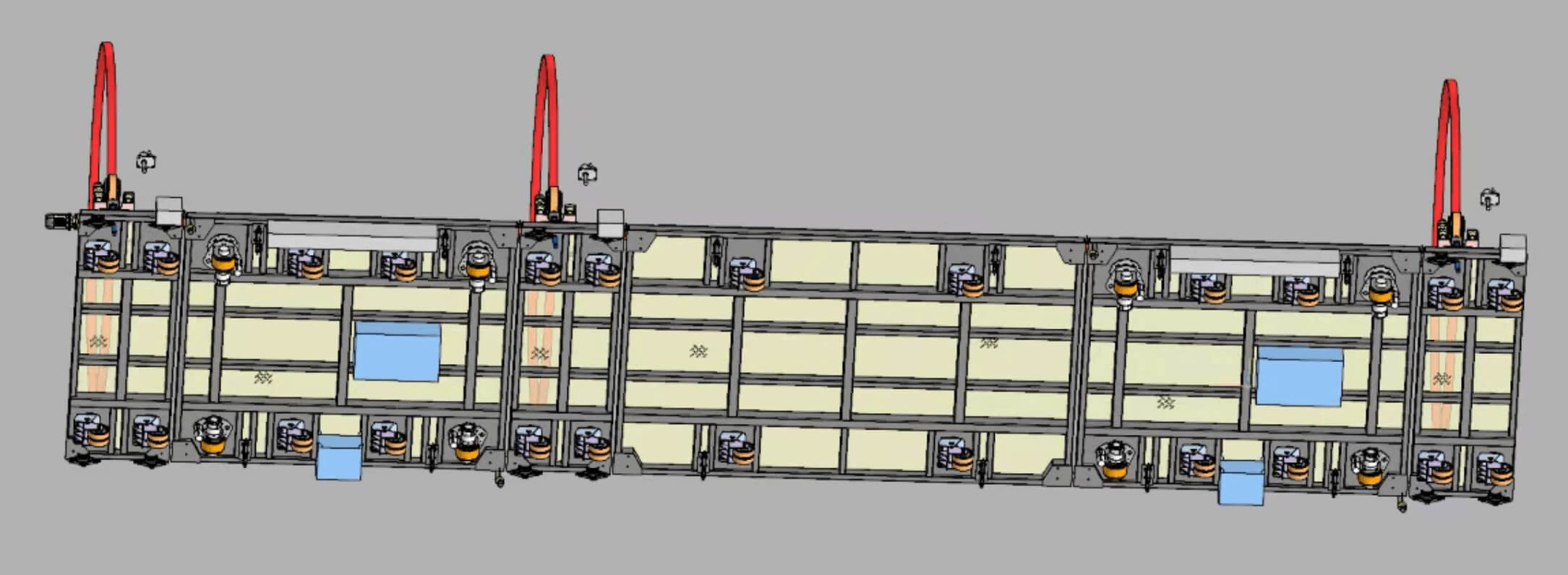
A customer came to us with a task no catalogue could answer. They needed to move loads up to 80 tons inside a plant, along a route longer than a football pitch, and no single rigid vehicle would do it. A rigid frame 25 metres long cannot turn in a factory aisle, and it cannot keep every wheel on the ground when the floor is not perfect. So the machine they asked us to build is not one vehicle. It is three, tied together by steel.
This is the story of that project. It covers how the cart is laid out, why the front and rear carts carry the electric drive wheels while the middle one runs on passive omni-directional wheels, and how we sized the drive wheels from the BXEC series. If you move heavy loads with AGVs, heavy-duty AGVs or AGV drive wheels, the sizing logic below runs the same way.
Rule of thumb: on a very long load, do not fight the length with a rigid frame. Split it into carts, give the outer carts the drive and steering, let the middle cart follow on passive wheels, and size every wheel for the full share of the load it will ever see, plus margin. Length and turning are a layout problem. Load and traction are a wheel problem. Keep them separate.
1. What the customer needed
The brief was for a non-standard transport machine, not a stocked product. The load was heavy, the route was long, and the use was indoors on a floor the customer described as very flat. Here is the machine we agreed on, in numbers.
| Item | Specification |
|---|---|
| Vehicle architecture | Three carts joined by mechanical steel members into one train |
| Total load capacity | 80 tonnes |
| Total length | Over 25 metres |
| Wheel count | 32 wheels in total |
| Drive wheels | 8 electric drive wheels, on the front and rear carts |
| Drive wheel model | BXEC-280, horizontal planetary drive wheel series |
| Travel motor | Three-phase AC asynchronous motor |
| Steering motor | Servo motor |
| Middle cart | Omni-directional mechanical shock-absorbing wheels only |
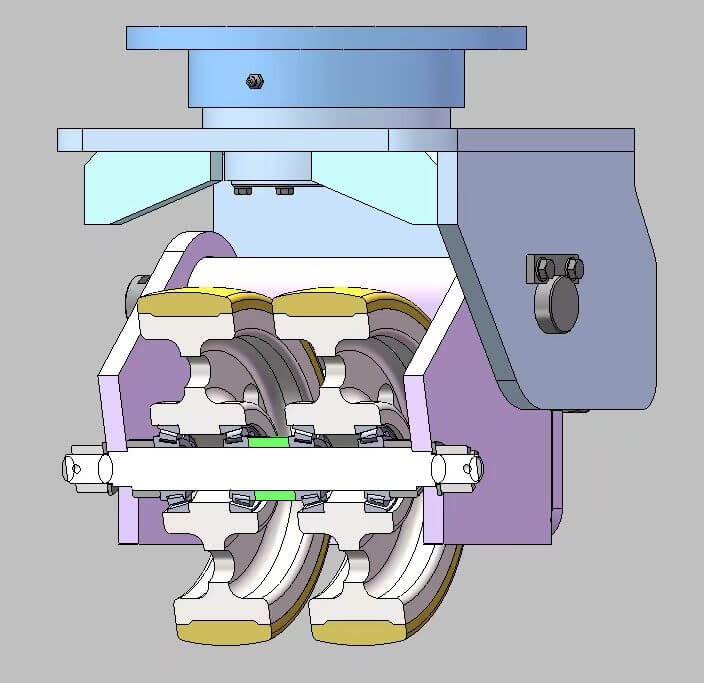
| Omni wheel rating | 1.8 t per single PU wheel, 3.5 t per assembled unit (one left + one right PU pair plus frame and springs) |
| Shock absorption | Four springs per wheel |
| Environment | Indoor, very flat floor |
2. Why three carts instead of one
The customer first pictured a single long platform. We talked them out of it, and the reason is geometry. A rigid 25-metre vehicle has a turning radius that no ordinary factory aisle can hold, and it behaves like a see-saw whenever the floor is not dead flat. Every extra metre of length gives any floor imperfection a longer lever arm against the frame.
Splitting the load into three carts joined by steel fixes both problems. Each cart is short enough to steer, and the joints between them let the train follow a curve the way a road train does. The steel members carry the pull and the push between carts. The carts carry the vertical load. One structure does not have to do both jobs at once, which is what makes a very long, very heavy machine workable at all.
3. Where the drive wheels sit, and why
We put the eight drive wheels on the front and rear carts, and left the middle cart passive. That is a deliberate choice, not a cost saving.
Traction needs weight on the driven wheel. On a long train the middle cart sits closest to the centre of the load, and giving the drive to the ends puts the driven wheels where the steering forces and the directional control are needed. The middle cart only has to carry load and follow. It does that on passive omni-directional mechanical shock-absorbing wheels, which take the vertical load and let the train swing through a turn without fighting it.
The split also makes the control simpler. Two end carts with drive and steering can be commanded as a pair. The middle cart has no motors to synchronise, so there is one less thing to keep in step when the train is fully loaded.
4. The BXEC drive wheel: AC travel, servo steering
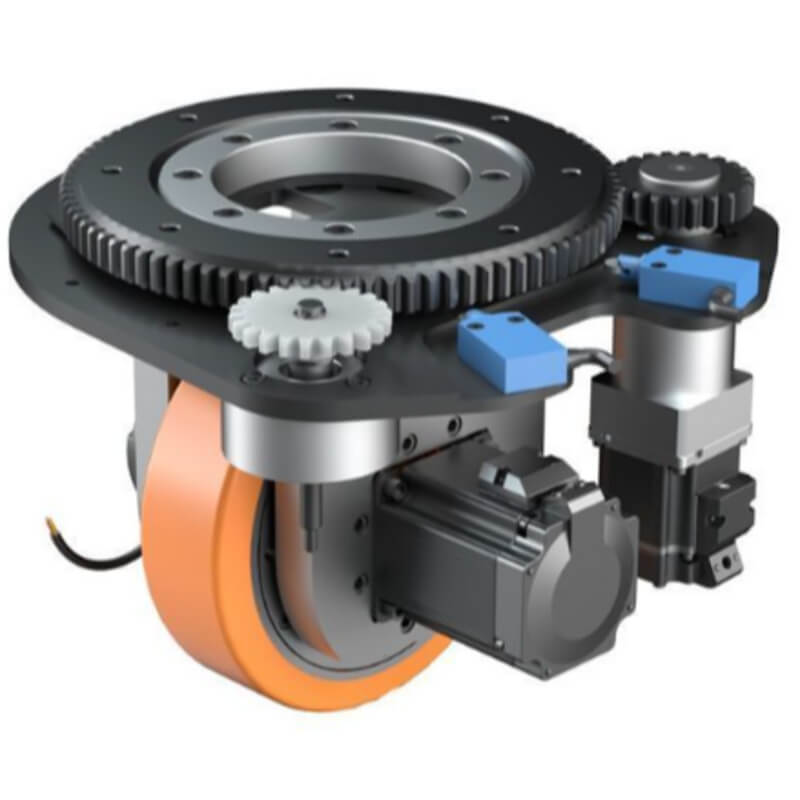
The drive wheel on this project came from our BXEC horizontal planetary drive wheel range, model BXEC-280. Each unit combines a planetary gearbox with a wheel hub in one compact horizontal block. The planetary stage reaches over 95 percent mechanical efficiency and produces high torque at low noise, which is what a heavy load needs at the wheel.
Two motors drive each unit, and they do different jobs. The travel motor is a three-phase AC asynchronous motor, chosen for smooth torque and low maintenance on a machine that runs long shifts. The steering motor is a servo motor, chosen because steering has to be precise and repeatable when a 25-metre train is being lined up. The pair is driven by an AC motor controller matched to the motor, which is where a lot of heavy-load projects quietly go wrong. Get that pairing wrong and the drive trips on overcurrent or loses its speed signal, the failure mode we set out in our AC traction motor failure guide.
| Item | Travel motor (three-phase AC asynchronous) | Steering motor (servo) |
|---|---|---|
| Power (S2-60 min) | 4000 W | 1000 W |
| Motor voltage | 48 V DC bus | 48 V |
| Rated speed | 2000 rpm | 3000 rpm |
| Rated current | 102 A | 26.4 A |
| Rated torque | 19 Nm | 3.18 Nm |
| Insulation class | F | F |
| Protection grade | IP54 | IP65 |
| Gear ratio | 1:40 | 1:50 |
| Brake torque | 16 Nm at 24 V | — |
| Wheel torque / output torque | 760 Nm at the wheel | 159 Nm |
| Wheel speed / output speed | 50 rpm | 60 rpm |
| Crown and pinion ratio | — | 38:127 |
| Wheel load capacity | 3000 kg per wheel | — |
| Max. radius of rotation | — | 335 mm |
| Rotate limit angle | — | ±150° |
| Lubrication | Grease | — |
A few things on that table are worth saying out loud. First, both motors run on a 48 V DC bus. That voltage is the natural choice for indoor battery-powered heavy-load machines: it sits below the 60 V safe-touch threshold in IEC 61800-5-1, so the cabling and the maintenance rules are simpler, and the current still stays reasonable at 4 kW (102 A on the travel motor). Second, the wheel-side numbers are the ones that matter for layout. The travel motor spins at 2000 rpm and is geared 1:40 to a wheel that turns at 50 rpm, which is about 6.6 metres per minute at a 250 mm wheel diameter. Slow and strong, not fast. Third, the steering motor swings through ±150° on a 335 mm radius, so each end cart can lay its drive wheels into a turn without the wheel hub clouting the frame. Fourth, the IP54 travel and IP65 steering split is deliberate: the steering motor sits closer to the floor and to splashing, so it gets the higher seal.
The BXEC series as a whole covers wheel diameters from 150 to 600 mm and loads from 600 kg to 20,000 kg per wheel, with input from 12 V to 96 V and motors from 400 W to 15 kW. Travel motors in the series can be brushed DC, AC induction or permanent-magnet servo. The project wheel, BXEC-280, sits in the middle of that range, and the table above is its custom electrical sheet for this build.
Available on the BXEC platform are options that a heavy-load job usually wants: a shock-absorption spring, limit switch, home sensor, incremental or absolute encoder, and potentiometer. Different combinations get used on different projects. That is the point of a modular drive wheel: the frame around it changes, the interface does not.
5. The omni-directional mechanical shock-absorbing wheels
The middle cart runs on passive omni-directional mechanical shock-absorbing wheels. They carry load and follow the train. They take no drive command.
| Item | Value |
|---|---|
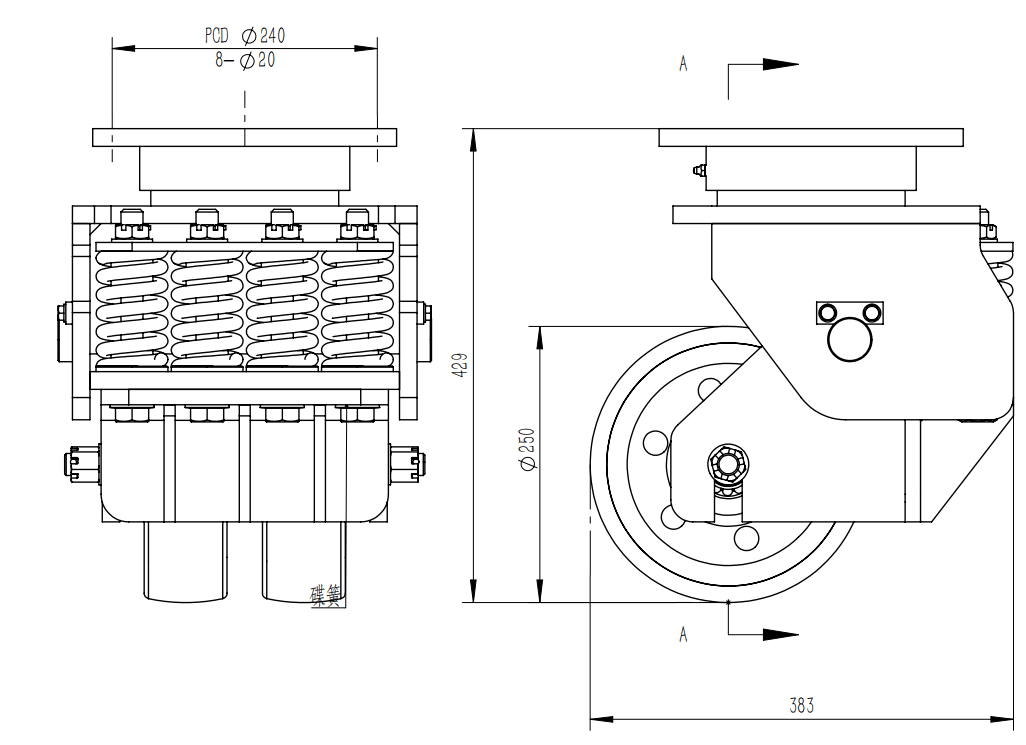
| Wheel diameter | 250 mm (10-inch PU double-row wheel) |
| Bolt circle (PCD) | 240 mm, 6 × M20 holes |
| Overall height with bracket | 429 mm |
| Bracket dimensions | 338 mm overall width, 258 mm mounting face, 75 + 75 mm double-wheel spacing |
| Bearing | GB/T 297-94 tapered roller bearing 32206 |
| Wheel surface | Polyurethane (PU) double-row, 45 steel hub |
| Springs per wheel | 4 helical springs |
| Single PU wheel load rating | 1800 kg (1.8 t) |
| Load per assembled unit (left + right PU pair) | 3500 kg (3.5 t) |
| Frame material | 16Mn steel |
| Spacer material | Plain carbon steel |
| Fastener | GB/T 6179-1986 type-1 hex slotted nut, grade C, M20 |
The 1.8 t per single PU wheel and 3.5 t per assembled unit numbers are why we run two PU wheels side by side in every omni wheel. The "3.5 t" you sometimes see quoted is the rating of the full assembly (left + right PU pair plus frame and springs), not of a single PU wheel. With 16 passive omni wheels on the middle cart, the total passive load capacity is 16 × 3.5 t = 56 t on the middle cart alone, which is well above the share of the 80 t it ever has to carry.
The four springs per wheel are what let a very long machine live indoors on a flat floor without every joint feeling every bump. On a train this long, a small floor variation at one end becomes a large vertical movement at the other. Springs at each wheel absorb that, keep the load spread evenly across the 32 contact points, and stop one wheel from hogging the load while its neighbour lifts clear.
Because the customer runs indoors on flat ground, we did not have to design for outdoor ruts, puddles or slopes. That single fact simplified the shock absorption and the sealing, and it is exactly the kind of thing the selection form is designed to capture before a design is frozen.
6. The selection form we send before every project
We ask every customer to fill in an AGV / electric transfer cart selection form before we quote, and this project is why. The numbers that matter are spread across the customer's site, their process and their load, and guessing one of them costs weeks. Here is what the form asks and why each line earns its place.
| What we ask | Why it changes the design |
|---|---|
| Total and per-wheel load | Sets wheel diameter and drive wheel rating. This is the first sizing input. |
| Machine length, width and route | Decides whether a rigid frame works or the load must be split into carts. |
| Indoor or outdoor, floor condition | Indoor flat floors allow simpler shock absorption and sealing than uneven outdoor ground. |
| Travel and steering speed | Sets motor power and the travel-to-steering motor split. |
| Required turning behaviour | Decides steering drive units versus differential drive. |
| Battery voltage and duty cycle | Decides the motor and controller voltage class and current rating. |
| Ramps, slopes or height changes | Adds or removes traction and braking margin on the driven wheels. |
| Environment: temperature, dust, water, washdown | Sets IP rating and whether explosion-proof or low-temperature variants are needed. |
| Communication and control interface | Decides encoder type and how the cart talks to the plant control system. |
A filled-in form turns a vague request into a specification. On this project the form is what confirmed that the floor was flat and the use was indoor, which let us size the shock absorption for a good floor instead of over-building for a bad one.
7. The heavy-load transfer cart and AGV market
Machines like this sit in a market that is growing fast. Grand View Research puts the global automated guided vehicle market at 5.93 billion US dollars in 2025, and projects it to reach 11.58 billion by 2033. LP Information sizes the global heavy-load AGV segment separately, at about 2.0 billion US dollars in 2025, growing to roughly 4.0 billion by 2032. Market estimates differ by how each house draws the boundary, but the direction is not in doubt: heavier, larger and more specialised automated transport is a growth segment, not a niche.
The driver is labour and safety. Moving an 80-ton load with a rigid vehicle means a large, slow, manual machine and a driver, and every move carries risk. An automated cart train that follows a fixed indoor route does the same job with fewer people near the load and more repeatable positioning. That is the same logic pushing growth across AGV drive wheel applications, from warehousing to heavy industry.
8. Why an electric drive wheel beats a separate motor, gearbox and wheel
An electric drive wheel is a motor, a reduction gear and a wheel built as one unit. A traditional drive is those three parts bought separately and assembled into the chassis. For heavy loads the integrated unit wins on several counts at once.
| Factor | Integrated electric drive wheel | Separate motor, gearbox and wheel |
|---|---|---|
| Space in the chassis | Compact horizontal block, one unit to mount | Motor, gearbox, coupling and wheel each need their own envelope and alignment |
| Efficiency | Planetary stage over 95 percent; matched gears and bearings from one supplier | Efficiency depends on parts from several suppliers and how well they are lined up |
| Steering integration | Steering can be built into the same unit as a steering drive unit | Steering needs a separate mechanism around the drive |
| Upfront engineering | Rated as a unit; load, torque and voltage come as one specification | Every interface, ratio and rating has to be worked out and matched by the integrator |
| Assembly and service | One part number to stock and swap | Multiple part numbers, and a failure is hard to trace across three components |
| Load per wheel | Rated per wheel from 600 kg to 20,000 kg across the BXEC series | Rated per component; the assembly rating is only as good as the weakest part |
The compactness point matters most on a heavy machine. On an 80-ton cart every millimetre of build height costs structure, and the horizontal drive wheel sits low and flat, which keeps the platform height down. That is why this project could use a low deck at all.
9. What we delivered
The machine was not a one-shot build. It took several rounds of discussion with the customer before the design was right, and that is normal for a non-standard machine. We went back and forth on the cart split, the wheel layout and the load path, and we delivered once the numbers agreed on both sides.
What we shipped was a three-cart train, over 25 metres long, rated to 80 tonnes, running on 32 wheels with eight BXEC-280 electric drive wheels on the outer carts and omni-directional mechanical shock-absorbing wheels carrying the middle. It runs indoors on a flat floor, which is the condition it was designed for, and it does the job the rigid vehicle could not.
If you are planning a heavy-load transfer cart, a custom AGV platform or a tow tractor build, the first useful thing you can send us is your load, your route and your floor. From there we size the wheels and the drive, the same way we did on this project.
Frequently asked questions
How do you carry 80 tonnes on 32 wheels?
By spreading the load and rating every wheel for its share plus margin. The omni-directional wheels alone are rated 3.5 tonnes each, and the drive wheels are rated as a unit within the BXEC series. The exact margin comes from the load per wheel on the finished design, not from the total divided evenly, because the load is not evenly distributed across a train this long.
Why not put drive wheels on all three carts?
Because the middle cart does not need them. Traction needs weight on the driven wheel, and the ends are where the steering and directional control belong. Passive omni-directional wheels on the middle cart carry load and follow the turn without adding motors to synchronise.
Why AC asynchronous for travel and servo for steering?
The travel motor runs long and hard and benefits from the smooth torque and low maintenance of a three-phase AC induction motor. Steering has to be precise and repeatable when a 25-metre train is being positioned, which is what a servo motor gives.
Does the middle cart need shock absorption too?
Yes. Every omni-directional wheel on this build has four springs. On a very long train, a small floor variation at one end becomes a large vertical movement at the other, and springs at each wheel keep the load spread across all 32 contact points.
What floor condition does the cart need?
This one was designed for an indoor, very flat floor, which is what the customer has. That is a design input, not an afterthought. If your site has slopes, ruts or washdown, tell us on the selection form, because it changes the traction, braking and sealing.
Can the same drive wheel work on a smaller AGV?
Yes. The BXEC series covers loads from 600 kg to 20,000 kg per wheel across wheel diameters of 150 to 600 mm, so the same platform scales from a light AGV up to a heavy machine. Choosing the size for your load is the subject of our AGV drive wheel selection guide.
Sources
- Grand View Research — Automated Guided Vehicle Market, 2026–2033. Global AGV market valued at 5.93 billion US dollars in 2025, projected to 11.58 billion by 2033. Source: grandviewresearch.com.
- LP Information — Global Heavy Load AGV Market Growth 2026–2032. Heavy-load AGV market from 2,007 million US dollars in 2025 to about 4,006 million by 2032. Source: marketresearch.com.
- ISO 3691-4:2023 — Industrial trucks: safety requirements and verification, Part 4: driverless industrial trucks and their systems. Source: iso.org.
- IEC 61800 series — Adjustable speed electrical power drive systems. Used here for the rule that drive, motor and feedback are specified as a single system.
- IEC 61800-3 — EMC product standard for power drive systems; the shielding and grounding rules that keep encoder signals clean.
- IEC TS 60034-25:2022 — AC electrical machines used in power drive systems; application guide for converter-fed machines.
- NEMA MG-1, Part 31 — Motors intended for use with adjustable-speed drives.
- Baoluo Motor product data — BXEC horizontal planetary drive wheel series: 600–20,000 kg load, 150–600 mm wheel diameters, 95 percent plus planetary efficiency, 12–96 V input, 400 W–15 kW motors.
Planning a heavy-load transfer cart?
Send us the load, the route and the floor. We will size the drive wheels, the motors and the controller in pairs, as one system, the same way we did on this 80-ton project.
- Describe your project or request a quote
- Browse the BXEC horizontal planetary drive wheel range
- Browse all AGV drive wheel series
- Read the heavy-duty AGV types and drive selection guide
About the author: the Baoluo Motor engineering team designs and builds electric drive wheels, traction motors and the controllers that drive them for heavy-load transfer carts, AGVs, tow tractors and electric vehicles. The company has been making traction and drive motors for special vehicles since 2004, is ISO9001 certified, and turns out more than 500,000 motors a year in over 800 specifications. These guides come from the bench and from machines we deliver, not from a catalogue.