An integrator came to us with an AGV that could not climb a ramp because someone had picked the drive wheel from a catalogue without checking the load. The motor was fine. The wheel was too small for the loaded weight, so the drive stalled on the incline. Sizing an AGV drive wheel is a small set of decisions — load, drive type, voltage and mounting — and getting any one wrong shows up as a stalled wheel, a burned motor or a broken gearbox weeks after the machine ships.
This guide walks the selection in the order you should make it, then maps it to the eight AGV drive wheel series we build, with their real load and size ranges.
Rule of thumb: decide three things first — the load per drive wheel (it sets the wheel diameter), whether the AGV steers by differential or by a steering drive unit, and the battery voltage. Everything else follows from those three.
1. Steering vs differential drive
The first decision is how the AGV turns, because it changes the whole chassis. There are two ways.
Differential drive uses two independently driven wheels. To turn, one wheel runs faster than the other, and the AGV pivots around the midpoint. It is simpler and cheaper, but turning in place is limited, and on a heavy machine the wheels scrub as they turn.
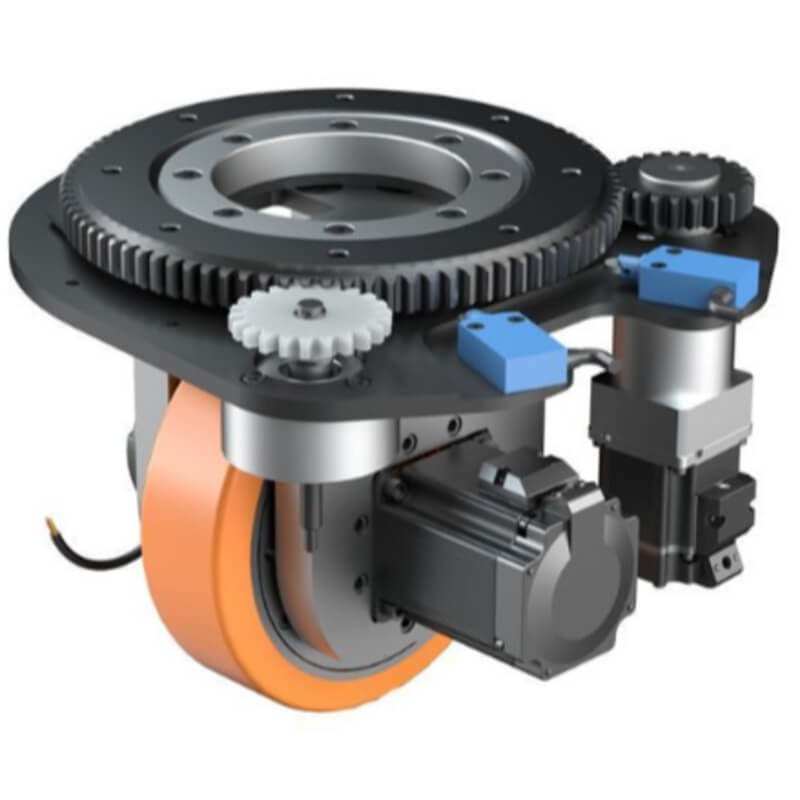
A steering drive unit packs the drive motor and a steering motor into one assembly, so the wheel both drives and steers. It lets the AGV steer like a car, turn in place, or move omnidirectionally, and it is the choice for tight aisles and precise docking. It costs more and adds a steering motor to control.
For the choice in one line: differential for open-floor, point-to-point movement; a steering drive unit for tight spaces, precise positioning and omnidirectional movement. The trade-off is covered in more depth in our heavy-duty AGV drive selection guide.
2. Load and wheel diameter
Wheel diameter is what sets how much the drive wheel can carry. The load each wheel sees is the vehicle weight plus payload, divided across the drive wheels, with a safety margin for ramps and acceleration. A bigger wheel spreads the load, climbs better and rolls over floor joints more easily; a smaller wheel keeps the chassis compact.
As a rough map from our own range: an 85 mm wheel carries about 500 kg, a 250 mm wheel around 1,600–1,800 kg, and a 550–600 mm wheel carries 20,000–23,000 kg. If you are unsure of the load, size up — an under-specified wheel is the most common AGV failure we see.
The full range, from 500 kg light robots to 23,000 kg coil and die transport, is spread across our differential and planetary series. Heavy-load options sit in the BDEC differential drive wheel (up to 23,000 kg) and the BXEC planetary drive wheel (up to 20,000 kg).
3. Vertical vs horizontal mounting
The mounting orientation decides how much vertical space the drive takes inside the chassis.
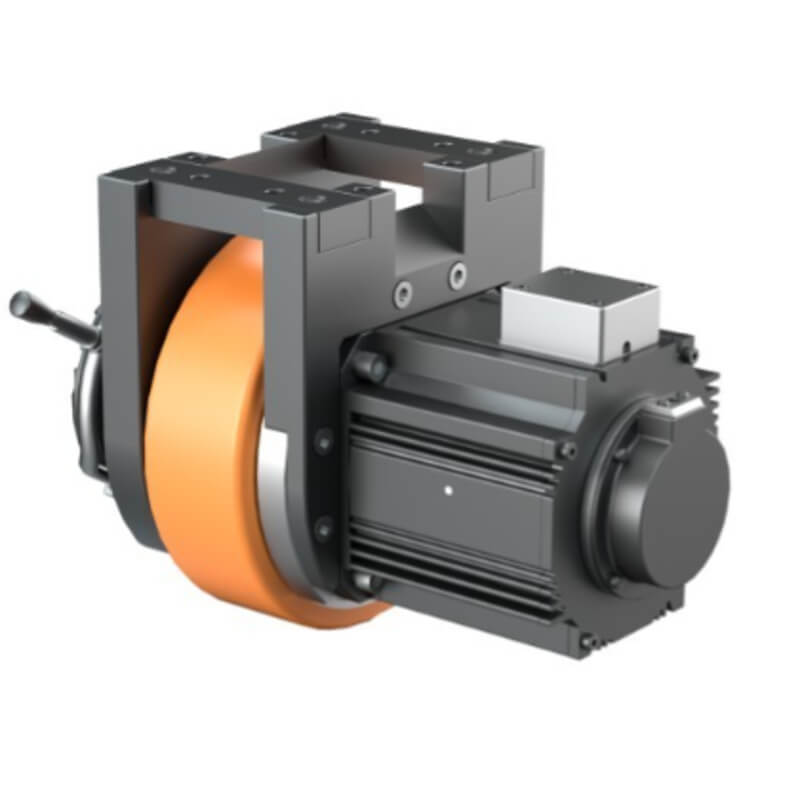
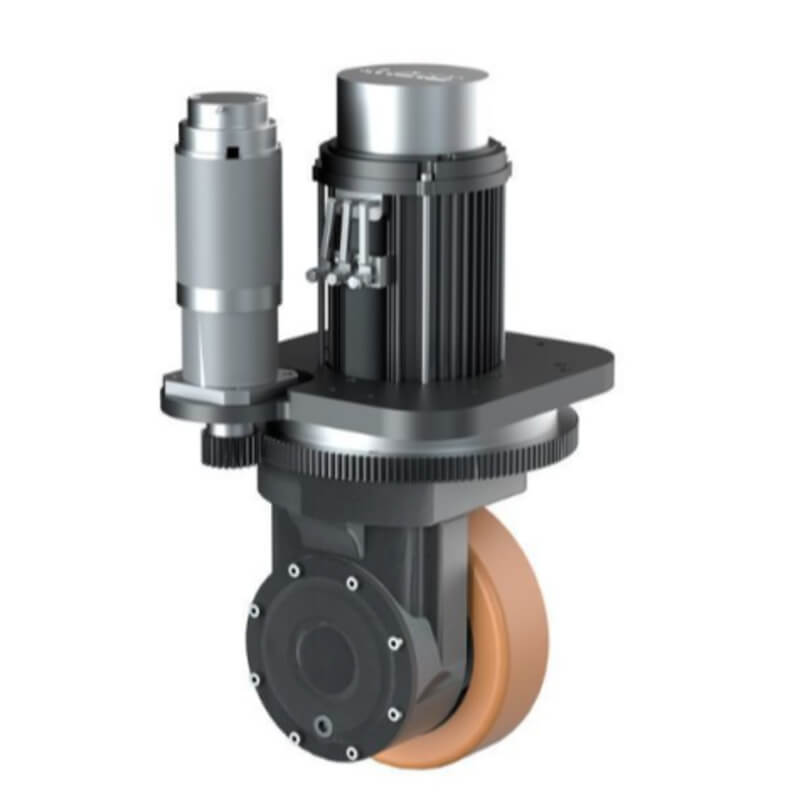
A vertical drive wheel stands the motor up, so the assembly is tall but takes a small footprint — good when floor space is tight but height is available. A horizontal drive wheel lays the motor flat, giving a low profile for AGVs that must drive under a load deck or a low conveyor.
In our range, the vertical non-steering and vertical steering series cover the vertical case, while the horizontal without steering and horizontal parallel-shaft series cover the low-profile case.
4. Voltage
Match the drive wheel's voltage to the battery pack, or the controller and motor will fight. Light, small robots often run 24 V; 48 V is the mainstream for warehouse AGVs; 72 V and 80 V appear on the heaviest machines where higher voltage keeps the current — and the cable size — down. Our drive wheels are built for 24 V, 48 V, 72 V and 80 V systems, with the heavy 72–80 V models reserved for the top of the load range.
5. Shock absorption and protection
Two refinements cover the machines that need them. A shock-absorbing drive wheel adds suspension travel, so fragile or precise loads — semiconductor wafers, glass, medical samples — ride smoothly over floor joints. Our BLJEC shock-absorbing series does this in a vertical mount, and the BJEC series adds the same suspension to a low-profile horizontal drive with steering, for fragile loads that must run under a deck.
The IP rating under IEC 60529 tells you what the enclosure keeps out. A standard drive wheel is IP54; for washdown or heavy-dust duty, our differential series offers IP65 on selected models. Match the rating to the site.
The eight series compared
| Series | Type | Load (kg) | Wheel (mm) | Voltage | Typical use |
|---|---|---|---|---|---|
| BDEC | Differential | 500 – 23,000 | 85 – 550 | 48 / 72 | Light robots to coil, paper and die transport |
| BLEC | Vertical with steering | 500 – 6,500 | 150 – 470 | 24 / 48 / 80 | Steering drive units for tight aisles, docking |
| BXEC | Horizontal planetary | 600 – 20,000 | 150 – 600 | 24 / 48 / 72 | Mid to extra-heavy AGVs |
| BWEC | Horizontal, no steering | 600 – 20,000 | 150 – 600 | 24 / 48 / 72 | Low-profile differential drive |
| BNEC | Vertical, no steering | 1,500 – 6,500 | 230 – 406 | 24 / 48 | Automated forklifts, storage shuttles |
| BEC | Horizontal parallel shaft | 800 – 3,000 | 167 – 300 | 24 / 48 | Light AGVs, AMRs, flat carts |
| BLJEC | Vertical, shock-absorbing | 1,200 – 2,500 | 230 – 310 | 24 / 48 | Fragile and precise loads, lab and medical |
| BJEC | Horizontal, shock-absorbing with steering | 500 – 1,600 | 150 – 250 | 48 | Fragile loads, low-profile steering |
Selection checklist
- Compute the load per drive wheel. Vehicle weight plus payload, divided across the drive wheels, with margin for ramps.
- Choose the drive type. Differential for open-floor point-to-point; steering drive unit for tight spaces and precision.
- Pick the wheel diameter from the load. Bigger wheel for more load and better climbing.
- Match the voltage to the pack. 24 V, 48 V, 72 V or 80 V.
- Choose vertical or horizontal. Vertical for footprint, horizontal for a low profile.
- Add shock absorption or a higher IP rating only if the load or site needs it.
- Confirm the controller. Size it to the drive's peak current, not just its rated power.
Frequently asked questions
What is the difference between a steering drive unit and a differential drive?
A steering drive unit has a drive motor and a steering motor in one assembly, so the wheel drives and steers, allowing in-place turns and omnidirectional movement. A differential drive uses two independent wheels that steer by running at different speeds. Differential is simpler and cheaper; a steering unit is better for tight spaces and precise positioning.
How do I calculate the load per AGV drive wheel?
Add the vehicle weight to the payload, divide by the number of drive wheels, then add a margin for ramps and acceleration. The wheel diameter is then chosen from that number — an under-specified wheel stalls or breaks under load.
What voltage should an AGV drive wheel be?
Match the battery pack. 24 V suits small robots, 48 V is the mainstream for warehouse AGVs, and 72–80 V serves the heaviest machines. A mismatch between pack and drive wheel causes controller and motor problems.
When do I need a shock-absorbing drive wheel?
When the AGV carries fragile, precise or vibration-sensitive loads — semiconductor wafers, glass, lab samples — and the floor has joints or uneven spots. A shock-absorbing wheel adds suspension travel so the load rides smoothly.
Vertical or horizontal drive wheel?
Vertical saves floor footprint and is the common choice; horizontal gives a low profile for AGVs that drive under a load deck or low conveyor. Choose by the space available in the chassis.
Sources
- IEC 60529 — Degrees of protection provided by enclosures (IP code), for the IP54/IP65 ratings.
- Baoluo Motor product specifications — load, wheel diameter, voltage, power and application data for the eight drive-wheel series, taken from the product pages.
- Industry selection guidance on steering-vs-differential AGV drives (HZ Drives, AGV Motor technical comparisons), for the drive-type framework.
Tell us the load and the space, and we will pick the wheel
Send us the total loaded weight, the number of drive wheels, the battery voltage and the height available in the chassis. We will match the series and size, and quote the drive wheel plus its controller as a tested set.
- Request a quote for an AGV drive wheel
- Browse the AGV drive wheel range
- Read the heavy-duty AGV drive selection guide
- Read the DC vs AC traction motor comparison
About the author: the Baoluo Motor engineering team designs and tests AGV drive wheels and low-voltage traction motors for warehouse automation, material handling and mobile robots. This guide reflects the specifications on our product pages and standard drive-selection practice, not theory alone.