1. Overheating
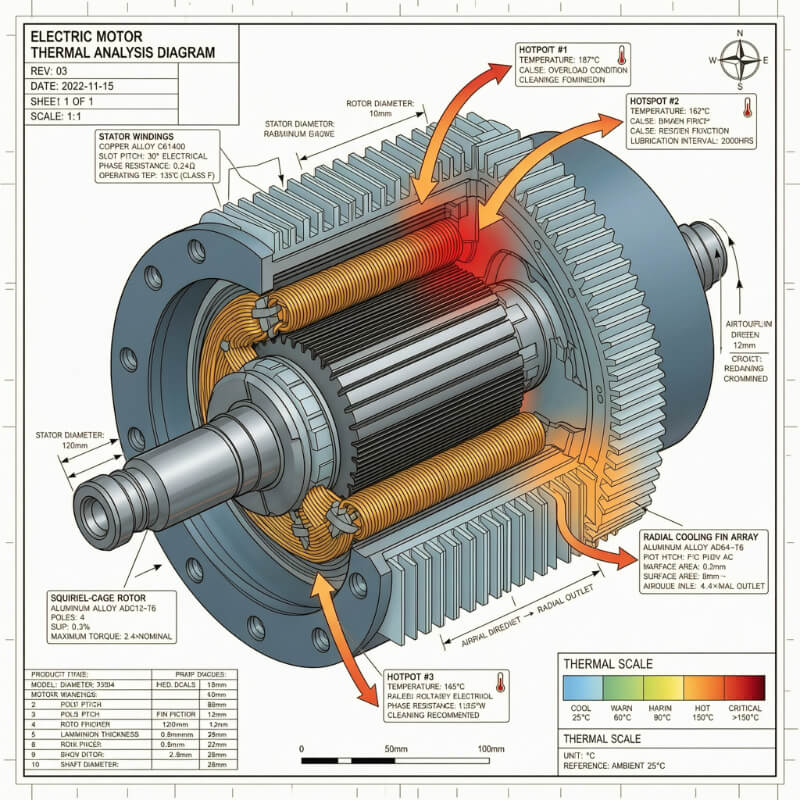
Heat is the failure that leads to every other failure, because it is what ages the winding insulation. An AC asynchronous motor has one heat source that a DC motor does not: the inverter. If the inverter's output waveform does not match the motor, the harmonics add iron loss, and the motor runs hotter than its load alone would explain.
The relationship between heat and life is steep. Insulation follows the 10-degree rule: every 10 °C of extra winding temperature roughly halves insulation life. A Class F winding rated for a 155 °C hotspot and designed for 20,000 hours will last roughly half as long at 165 °C, and about twice as long at 145 °C.
Heat comes from seven places worth checking: overload, blocked cooling airflow, an ambient temperature above 45 °C, low supply voltage, frequent starting (start current is 3–5 times rated), a mismatched inverter, and a worn bearing.
Prevention:
- Stay within the rated load and duty cycle, and keep the ambient under 45 °C.
- Keep cooling passages clear.
- Check frame temperature on a schedule with a hand-held thermometer.
- Match the inverter to the motor — a mismatch shows up as heat first.
2. Inverter mismatch and electrical problems
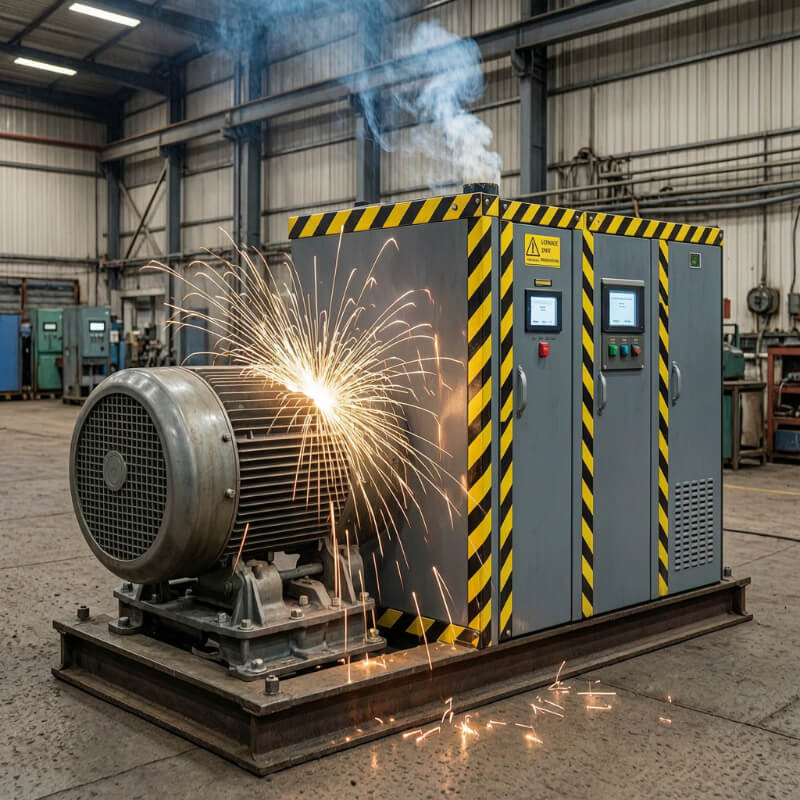
An AC asynchronous motor will not run without an inverter to convert the battery's DC into variable-frequency AC. That makes the inverter both a necessity and a failure point. A mismatch between inverter and motor adds harmonics to the output, and those harmonics become extra iron loss and heat in the motor. Voltage spikes from a poorly matched drive can also stress the winding insulation.
Our C750 series AC motor controller is sized in pairs with our motors for this reason. A matched controller also brings the protections that stop a fault from becoming a fire: overcurrent, overload, over-temperature, and regenerative braking.
Prevention:
- Use an inverter matched to the motor's voltage and current, not one bought by price.
- Read the fault codes instead of resetting them — overcurrent and over-temperature codes are the motor asking for help.
- Check terminal tightness on a schedule; a loose terminal arcs and heats.
- Confirm supply voltage before a new installation.
3. Bearing failure
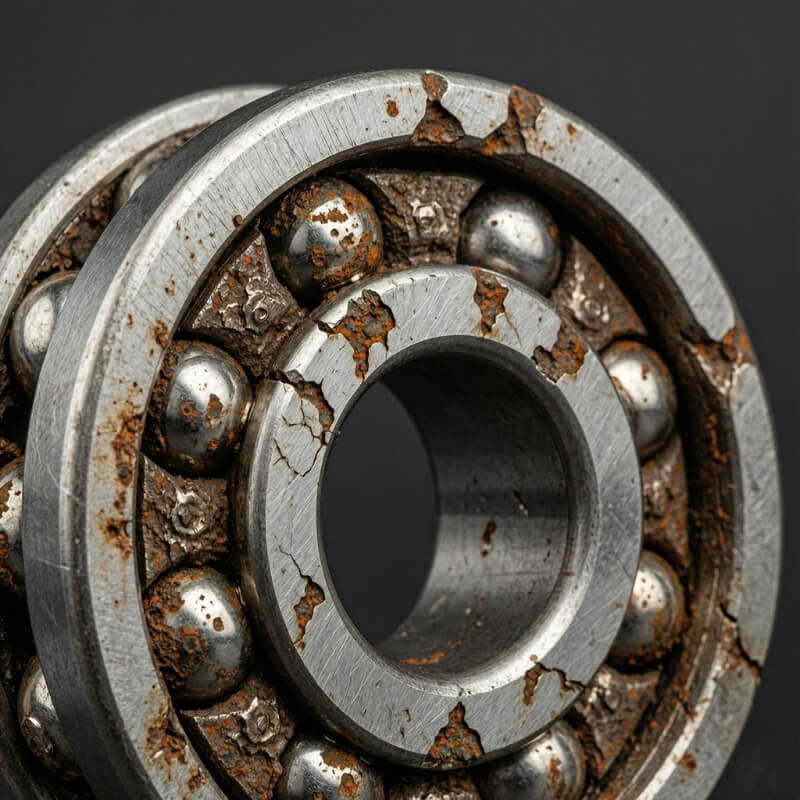
Bearings take the radial load from the drive, and on an AC traction motor they usually fail from lubrication loss, contamination or misalignment. The warning signs are the same as any motor: vibration first, then a change in running noise, then a scored or seized bearing.
The right bearing depends on where it sits. A deep-groove ball bearing is fine at both ends of a small motor. A higher-power AC motor wants a cylindrical roller bearing at the drive end to take the radial load. A heavy traction or high-vibration duty wants a spherical roller bearing that self-aligns and absorbs shock.
An inverter-fed motor has one bearing hazard a DC motor does not: electrical discharge across the bearing. The drive's common-mode voltage can push a small current through the bearing and pit the race over time, a failure that turns up as a roughening, noisy bearing with no obvious mechanical cause. Proper grounding and a matched drive are the countermeasures.
Prevention:
- Lubricate on schedule, and do not over-pack the housing.
- Watch for new vibration or a change in running sound.
- Swap a rough bearing before it scores the shaft or lets the rotor touch the stator.
4. Dust and moisture contamination
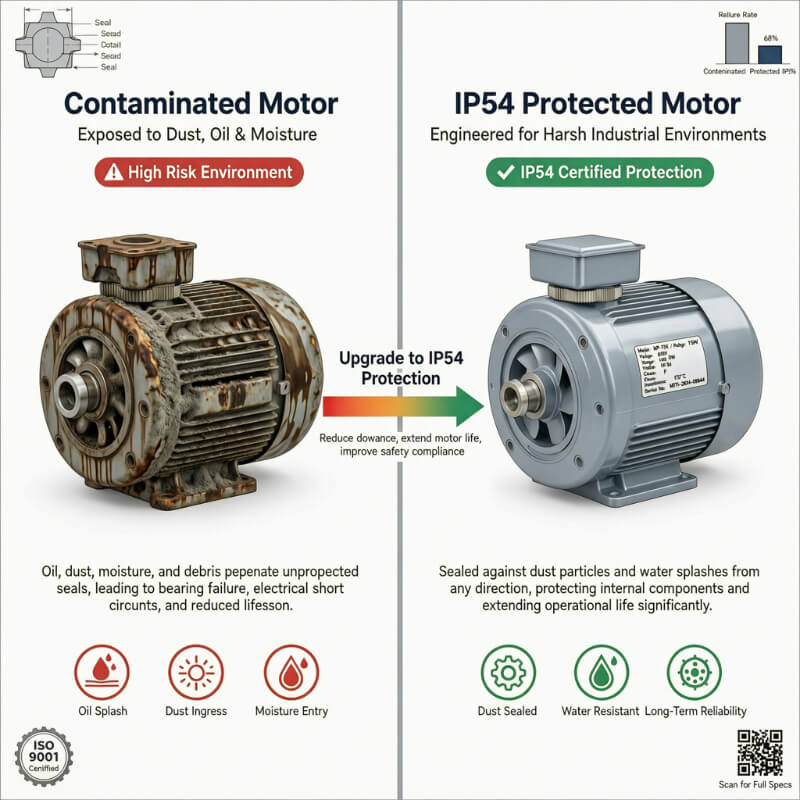
Dust, oil and moisture slip in through the same openings the motor uses to breathe. Once inside they cut insulation resistance, clog the cooling airflow and flush grease out of the bearings. On a dusty site, the air around the motor is as much the problem as the motor itself.
The defence is the enclosure rating under IEC 60529. Our AC traction motors are built to IP54: the "5" keeps dust out, the "4" handles water splashes. For a washdown environment, match the enclosure to the site.
Prevention:
- Clear the cooling openings and wipe the housing down on a schedule.
- Pick an enclosure rated for the actual site.
- Look for water inside after a washdown or a wet season.
5. Winding insulation breakdown
Everything above eventually lands on the windings. Insulation breaks down from heat, from voltage spikes, or from a winding that was wound poorly to begin with. The quality of the winding — how tightly and evenly the copper is packed into the stator slots — decides how consistently the motor runs cool, and how long the insulation lasts.
Two things separate a good winding from a cheap one: slot fill and varnish. A machine-wound stator reaches a higher, more even slot fill, so copper loss and temperature stay consistent from one motor to the next. Vacuum pressure impregnation then fills every gap in the winding with varnish, leaving no air pockets where heat can concentrate and no path for moisture to creep in.
Prevention:
- Buy from a maker who winds and varnishes to a standard, not by hand to a price.
- Watch for a hot spot or a burnt smell — both point at the insulation.
- Test insulation resistance as part of routine service.
Quick diagnosis guide
| Symptom | Most likely cause | Check first |
|---|---|---|
| Motor runs hot | Overload or inverter mismatch | Load, inverter parameters, cooling airflow |
| Inverter trips on overcurrent | Overload or voltage spike | Load, drive settings, wiring |
| Abnormal vibration | Bearing damage or misalignment | Bearing play, coupling alignment |
| Change in running noise | Bearing or winding fault | Bearing condition, insulation resistance |
| Burning smell | Insulation breakdown | Winding temperature, insulation resistance |
Frequently asked questions
What is the most common cause of AC motor failure?
Overheating. On an AC asynchronous motor the heat usually comes from overload, poor ventilation, or a mismatched inverter adding harmonic loss. Heat is what ages insulation, and a burnt winding is how the motor eventually ends.
Why does my AC motor run hot with an inverter?
If the inverter does not match the motor, its output waveform carries harmonics, and those harmonics become extra iron loss inside the motor — heat that has nothing to do with the load. A matched drive, like the C750 series AC motor controller we pair with our motors, avoids most of it.
How long do AC traction motor windings last?
It depends entirely on temperature. A Class F winding is rated for a 155 °C hotspot, and by the 10-degree rule every 10 °C above that roughly halves its life. Run cool and it lasts; run hot and it does not. That is why temperature is the first thing to monitor.
Does an AC asynchronous motor need a controller?
Yes. It will not run on battery voltage alone. The AC motor controller converts DC into the variable-frequency AC the motor needs, and it is also what provides overcurrent, overload and over-temperature protection.
What IP rating should an AC traction motor have?
IP54 is a good floor for most vehicle duty — dust-protected and splash-proof under IEC 60529. For washdown or heavy-dust sites, go higher. Match the enclosure to the environment, not the other way around.
Which fails less, an AC or a DC motor?
An AC asynchronous motor has no brushes or commutator to wear, so it needs less routine attention there. A DC series-wound motor gives simpler control and strong low-speed torque. The real answer is that each fails differently, and the choice comes down to your duty — that decision is set out in our DC vs AC traction motor guide.
How we build against these failures
Prevention helps, but the motor's starting point matters more. The XYQ-5FE03A and the larger XYQ-10PC01 are three-phase AC asynchronous traction motors built for heavy forklifts, tow tractors and electric vehicles, and every unit goes through the same checks before it ships:
- Machine winding for an even slot fill, so copper loss and temperature stay consistent across every motor.
- Vacuum pressure impregnation of the winding, so no air pocket or moisture path is left behind.
- 100% load testing, dynamic balancing, and an electrical safety inspection before packing.
Baoluo Motor has built special-vehicle traction motors since 2004, holds ISO9001, and produces more than 500,000 motors a year across 800+ specifications. If you are choosing between two AC motors that look identical on paper, the difference is usually in the winding, the varnish and whether the maker actually tested the unit you are holding. The same checklist applies to a brushed motor, which we covered in brushed DC motor quality. For the DC side of the same story, see top 5 causes of DC motor failure.
Sources
- IEC 60085 — Electrical insulation: thermal evaluation and designation (Class F = 155 °C).
- IEC 60529 — Degrees of protection provided by enclosures (IP code).
- IEC 60034-1 — Rotating electrical machines: rating and performance.
- Springer (2022), "A Review to Diagnose Faults Related to Three-Phase Industrial Induction Motors" — failure distribution: bearings 41%, stator windings 37%.
- EASA — "Failures in Three-Phase Stator Windings" (electrical apparatus failure modes).
- Baoluo Motor Enterprise Knowledge Base — insulation life and the 10-degree rule (Section 22.3), heat sources (Section 22.4), winding and varnish processes (Section 23), bearing types (Section 19.4), factory facts (Section 1).
Send us your drive and we will tell you what is wrong
Send the motor's voltage, the inverter you are running, and a description of the symptom — or a photo of the fault code — and we will point at the cause and what to change.
- Request a quote or ask about a failing AC motor
- Browse the AC traction motor range
- Browse the AC motor controller range
- Read the DC vs AC traction motor comparison
About the author: the Baoluo Motor engineering team designs and tests three-phase AC asynchronous traction motors and DC series-wound motors for forklifts, tow tractors, AGVs and electric vehicles. These guides are written from what we see on the test bench and in field returns, not from theory alone.