By the Baoluo Motor Engineering Team · Published 2026-09-05 · Updated 2026-09-05
An RFQ landed on my desk last year that read, in full: "48V forklift motor, 1 set, please quote." One motor. For a machine that needs two completely different ones. We wrote back and asked which job it was for — moving the truck across the floor, or lifting the load off it. The buyer had not realised those are two separate drive systems, and the quote he eventually needed was four parts, not one.
That confusion costs real money. Spec the wrong motor for the lift circuit and the pump bogs down under load or the motor cooks on a busy shift. Spec the wrong one for travel and you lose speed on ramps and drain the pack early. This guide separates the two jobs, then shows how both were specified on a real 1.5–2 ton four-wheel counterbalance forklift. We supplied the drive set for one of these machines: a 48V 8kW AC traction motor for travel, and a 6.3kW DC pump motor for lift and steering.
Rule of thumb: travel runs for hours, so the motor has to hold speed across a wide range and shed heat the whole time. That points to an AC asynchronous unit. Lifting is a different job again: short bursts from a standstill, where the pump needs peak torque at low speed, which is what a series-wound DC motor gives you. Size each controller to the surge current rather than the rated current and you are most of the way there.
Why a forklift needs two different motors
Travel and lifting ask for opposite things. Travel is a continuous load: the motor holds speed across a shift, climbs ramps, and has to shed heat the whole time. Lifting is an intermittent load: the hydraulic pump has to break free from a standstill and build pressure in a burst, then rest while the load is moved.
| Requirement | Traction (travel) | Pump (lift and steering) |
|---|---|---|
| Load pattern | Continuous, long duty | Intermittent, short bursts |
| What matters most | Speed range, efficiency, cool running | High torque at low speed |
| Typical motor type | Three-phase AC asynchronous, or DC series-wound | DC series-wound |
| Duty rating | S2-60min | S2-15min |
| Consequence of undersizing | Overheating, lost ramp speed, short battery range | Slow or stalled lift, burnt windings |
That split is why this machine runs an AC traction motor for travel and a series-wound DC unit for lifting, rather than two of the same motor. If you are still weighing the two technologies against each other, that decision is written up separately here: DC vs AC traction motor.
Travel: 48V 8kW AC traction motor (XYQ-8PC01)
The travel motor is the XYQ-8PC01, an 8 kW three-phase AC asynchronous motor. It runs from an inverter, which is where the wide speed range in the table below comes from. There are no brushes and no commutator, so the service list is short.
| Parameter | Specification |
|---|---|
| Rated power | 8 kW |
| Battery voltage | 48V DC (rated 34V AC) |
| Rated current | 190 A |
| Rated speed | 1450 rpm |
| Frequency range | 10–200 Hz |
| Duty cycle | S2-60min |
| Protection | IP54 |
| Feedback | 64 P/rev encoder, with temperature sensor |
| Mounting | Standard B5 flange |
Two numbers on that table carry the most weight. The 10–200 Hz frequency range is what lets one motor cover both slow inching around a pallet and open-floor travel across the warehouse. And the encoder plus temperature sensor give the controller the feedback it needs to protect the motor during heavy-load starts and ramp climbs, instead of letting it cook silently.
Travel controller: C750, model 7240
A three-phase AC asynchronous motor will not turn without a matching inverter. We paired the XYQ-8PC01 with the C750 series AC motor controller, model 7240.
| Parameter | Specification |
|---|---|
| Voltage range | 48–72 V |
| Rated output current | 120 A |
| Max output current | 400 A |
| Max output power | 25 kW |
| Protection | IP66, −30°C to +55°C |
| Control | Vector control with regenerative braking |
| Interface | CAN bus, online programming |
The 400 A peak is the figure that matters here, because it gives the startup surge somewhere to go. Regenerative braking then feeds energy back into the pack on deceleration, which stretches shift length on a single charge. The IP66 housing is what survives warehouse dust and washdown.
Lift: 48V 6.3kW series-wound DC pump motor (XQD-6.3-1SW)
The lift and steering pump runs on the XQD-6.3-1SW, a 6.3 kW series-wound DC motor.
Why series-wound for the pump? A hydraulic pump is hardest at the instant it is called on: it has to break free from rest and bring the whole system up to pressure. In a series-wound motor the field winding carries the full armature current, so it delivers peak torque at exactly that moment. As flow stabilises and load eases, the motor speeds up on its own. You get that curve from the way the motor is wound, not from anything the controller has to calculate.
| Parameter | Specification |
|---|---|
| Rated power | 6.3 kW |
| Rated voltage | 48V DC |
| Rated current | 172.8 A |
| Rated speed | 1550 rpm (up to 3200 rpm) |
| Duty cycle | S2-15min |
| Protection | IP44, Class F insulation |
| Shaft | Inner cross spline |
S2-15min is the honest limit. S2 is the short-time duty rating defined in IEC 60034-1, and 15 minutes is what this motor is built for: intermittent lifting, not continuous running. If your duty is heavier than that, move up a frame instead of pushing this one. Its Class F insulation is rated to 155 °C under IEC 60085.
Because it is a brushed machine, the pump motor is also the part with a wear item. Inspect the carbon brushes every 2,000–3,000 hours of service and replace them once wear reaches about a third of the brush length. The brush caps on this unit are accessible without special tools. If you want to go deeper on brush material and wear behaviour, the full write-up is here: DC motor carbon brush selection.
Lift controller: 400A DC
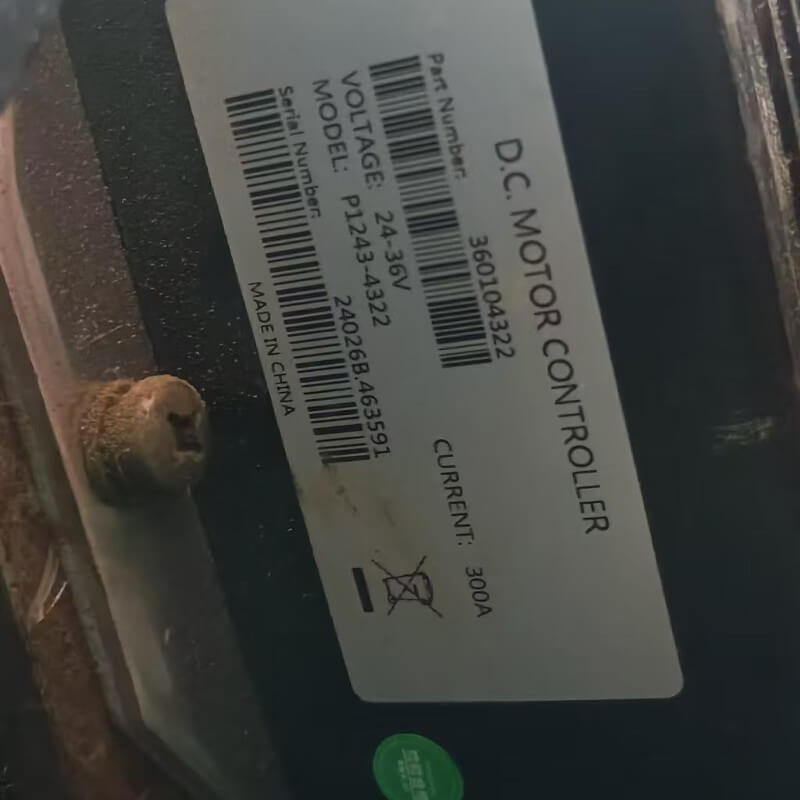
The pump motor draws 172.8 A rated, and its startup inrush goes well above that. For the pump side we use the 400A DC motor controller, whose 400 A maximum covers that surge, with built-in overcurrent, overload and over-temperature protection on the pump motor itself.
The complete four-part set on a 2-ton forklift
Put together, here is the complete drive set for a 1.5–2 ton four-wheel counterbalance forklift:
| Function | Part | Model | Key spec |
|---|---|---|---|
| Travel | AC traction motor | XYQ-8PC01 | 48V / 8 kW / 1450 rpm |
| Travel | AC controller | C750-7240 | 48–72V / 400 A peak |
| Lift and steering | Series-wound DC pump motor | XQD-6.3-1SW | 48V / 6.3 kW / 1550 rpm |
| Lift and steering | DC controller | 400A DC | 400 A max |
These four parts are meant to be bought together. The controllers are sized to the motors' surge currents, and the motors are matched to the travel and lift duty of the machine. Mixing an arbitrary motor with an arbitrary controller is where most forklift builds run into trouble — usually as a tripped controller or a burnt motor a few weeks into service.
Selection checklist
- Separate travel from lift. Establish the load pattern of each before you pick a motor type at all.
- Match voltage to the pack. All four parts here run on 48V. Keep the pack and every component on the same voltage.
- Size the controller for surge, not rated current. Check the peak (max) current rating, not just the continuous one.
- Respect the duty cycle. A pump motor rated S2-15min cannot run continuously. Derate if your duty is heavier.
- Confirm the mechanical interface. Check flange and shaft before ordering — this pump motor uses an inner cross spline.
- Check the protection rating against the environment. Dust and washdown justify IP54 or better on the traction motor and IP66 on the controller.
- Plan for the brushes. On the DC side, brush inspection is a scheduled job, not a repair job.
Frequently asked questions
AC or DC for a forklift traction motor?
Both are used. A three-phase AC asynchronous motor gives a wide speed range and no brushes to service, which is why this machine uses AC for travel. A DC series-wound motor gives simpler control and strong low-speed torque, and remains common on smaller or cost-driven machines. The full trade-off is set out in our DC vs AC traction motor guide.
Why is the lift pump motor DC series-wound?
Because a hydraulic pump needs maximum torque at the instant it starts to build pressure. A series-wound DC motor delivers its peak torque at low speed, which is exactly when the pump needs it, and then speeds up on its own as flow stabilises.
What does an AC forklift motor need that a DC one does not?
An inverter. A three-phase AC asynchronous motor will not run on battery voltage alone. The C750 controller above converts the pack's DC into the variable-frequency AC the motor needs, so it is a required part of the build rather than an optional extra. A series-wound DC motor, by comparison, runs on a simpler DC drive.
How do I size a forklift motor controller?
Pick a controller whose peak (max) current covers the motor's startup surge, at the same voltage as the pack. On this machine that means a 400 A peak AC controller for the 8 kW traction motor and a 400 A max DC controller for the 6.3 kW pump motor.
How often do forklift pump motor brushes need attention?
Inspect them every 2,000–3,000 hours of service and replace them once wear reaches roughly a third of the brush length. Brush life varies with load and duty, so treat that as the inspection interval rather than a fixed replacement date. More detail is in our carbon brush selection guide.
How much horsepower is a 48V forklift motor?
On this machine: 8 kW is about 10.7 hp and 6.3 kW is about 8.4 hp, using the standard 1 hp = 0.7457 kW conversion. Horsepower is not usually the figure forklift builders spec against, though — duty cycle and torque at low speed matter more.
What protection rating do forklift motors need?
For a warehouse floor with dust and washdown, look for IP54 or higher on the traction motor and IP66 on the controller. Those two-digit codes are defined in IEC 60529: the first digit is protection against solid ingress, the second against water. The pump motor here is IP44, which is acceptable for its enclosed mounting position.
Send us the forklift spec and we will size the set
Tell us three things and we can usually come back with a matched set: the truck's rated capacity in tons, the battery pack voltage, and how hard the duty is — shifts per day, ramp gradients, and whether lifting is continuous or occasional. We supply all four parts as a matched, load-tested set.